What is the GIA?
The GIA (Gemological Institute of America) are one of the most recognisable companies for stone grading world wide. They helped standardise diamond grading and create a system in which we could potentially put a value on a stone. This is done by documentation, inscription and record keeping. GIA only grade loose diamonds, but they have many certification labs throughout the world.
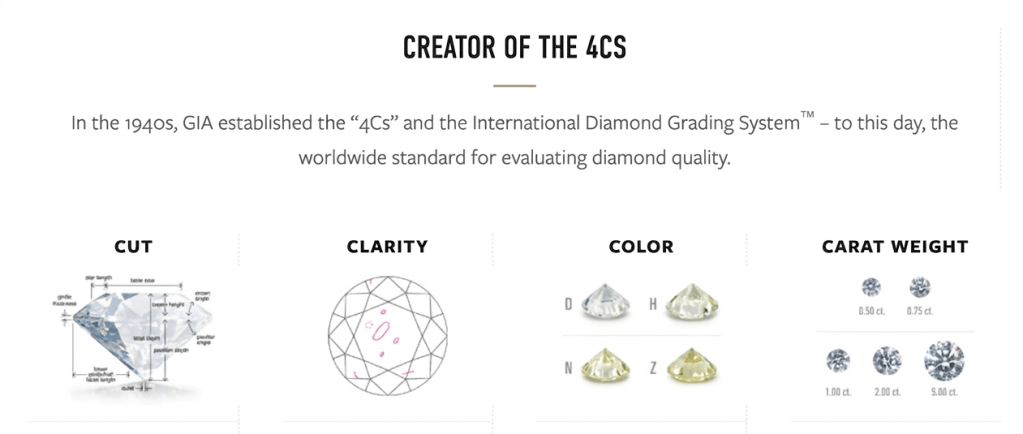
Cut
The cut of the stone is what creates the “fire” of the stone. Basically, the sparkles.
To get the best fire, the cut plays a big part of this. It is how light bounces around in the diamond and reflects the light back out to the beholder. The round stone being one of the best at creating fire, this is due to a proportions and symmetry that a round stone can produce. The ‘brilliant round’ is the only stone which can be given diamond cut grades because they typically have standardised facets.
Round brilliant diamonds have about 57-58 facets. Facets are the cuts made into the stone to direct the light through the stone. The brilliant cut has been developed over time, and the history of the diamond cut is an interesting one.
Other shapes: Marquise, Emerald, Pear, Oval, Hearts, Triangles
These other shapes are known as ‘fancy’.
Clarity
Clarity is how clear the stone is. Each stone might have some sort of flaw, this is because with natural stones they have been grown from the earth and therefore imperfections can happen as they grow over time. These blemishes are defined by multiple ways:
Feathering: This can appear like a little ‘wisp’ inside the stone. Feathering can create a small fracture and therefore bounce light away from the cut facets. Feathering can also be a bad thing, particularly if it occurs near the edges of the stone. This is because it can cause a weak point, which could then develop into a chip. A stone might have multiple feathers within the stone, more feathers means a degraded clarity.
Carbon: These are little black spots in the stone. Naturally, diamonds are made from carbon so sometimes not all the parts of carbon is turned into our wonderful clear stone. It can be speckled throughout the stone. Some collectors actually like the carbon spots and are known as ‘salt and pepper’ diamonds. They can look beautiful in their own right, and often like a little galaxy. Unfortunately, as a grading perspective – carbon spots are a means to downgrade the stone.
Pin points: These also link to clouding and feathering – they are small amounts of crystal which are ‘clumped’ together inside the stone, reducing the clarity. Again like feathering it is a cause for downgrading the stone quality.
There are many things which can affect a diamonds clarity, hence why the GIA create a ‘inclusions’ report: https://4cs.gia.edu/en-us/diamond-clarity/
Colour
The ideal diamond is clear or ‘white’. The whiter and brighter, the more desirable. Now, there is a little history to the colour scaling: The typical colour scale which all diamonds are measured on goes from D-Z. D being the most desired, and Z being the least. That is the very basics.
But what I found fascinating is the history of what happened to A-C?
The GIA quantified colour. In the 1950’s diamonds never used to have a standardised system for grading. So jewellers could define the stones as A, B, or C grades. So because these systems were using A,B,C – the GIA just started a fresh grading system – starting from D so not to confuse against any of the previous grading systems. https://www.gia.edu/gia-news-research/transformation-diamond-cut-quality-grading
Carat Weight
This one is fairly straight forward – how big is my rock? Now the GIA have defined a metric carat as 200 milligrams. The term carat weight has been used since the 1500s with early gem traders. It is recognised globally, and it can also help determine a ‘fake’ diamond from a real one if it doesn’t measure up by weight. For example: A cubic zirconia stone won’t weigh the same as a diamond. So if a dealer say’s the stone is 3cts, this might be true but then the stone could be weighed to help determine the type of material the stone is made from. Now, one thing I would like to touch on is ‘Total Carat Weight’. This is jewellers marketing ploy I feel, and learnt the hard way between melee stones and bigger sizes. Most places might define a piece of total carat weight, and it has a hundred little diamond stones. Technically they are correct, but when looking at the stones individually – they might only total an amount of 0.05ct each. If all these little stones are unset, then they would not be worth as much as say one stone of similar carat size. This is important distinction to make when buying jewellery.
Why is it important? Because it can make the piece appear more valuable than it is. A larger stone of better quality will always be worth more than a dozen little stones. Hence, they are referred as melee. I personally class anything under 0.10ct as melee. This is because they can be used more-so as accent stones, in illusion settings, or in halo settings to try give the impression of a more expensive design.
Alternatively, if you have a 3ct large one stone diamond, but it is a grade O colour (more yellowed), and it has multiple inclusions, and has been cut badly – then your large stone may not have a lot of ‘worth’. Now, I am loosely saying worth because, well a stones true value is in the buyer, if they love a stone and its appearance you can’t really put a price on it. https://4cs.gia.edu/en-us/diamond-carat-weight/
Important distinction, although GIA have many, many labs around the world they do not have one in Europe.
Further reading:
Other Diamond Certifiers
So, the GIA has a way of measuring diamonds. What really makes them important though is that a stone graded by the GIA has strict parameters which could make your stone a high grade, therefore ‘more valuable’, or a low grade which might be considered less desirable.
Founded in 1975 in Antwerp, they are not related to commercial sales. They issues IGI certificates and diamond reports and also a hearts and arrows reports. The IGI are known to be ‘kinder’ with their evaluations compared to GIA. This doesn’t take away from the overall report – but what might be a colour grade M in a GIA report might show as a K or a L in a IGI report. Now, IGI are doing something unique with the Lab/ synthetic diamond trade. There has been a lot of controversy with the ‘Lab-Boom’ which is happening in modern diamonds (as 2026).
Lab grown diamonds have their foot firmly in the door of consumers. With lab grown diamonds, they are able to replicate a 3-4 carat diamond for the fraction of the price. They are able to create any shape/ size (colour is debatable at the moment), and people can even create a ‘designer-diamond’ to their own specifications. This has caused a whole thing.
IGI are important because, GIA has announced in 2025, that they will not grade lab-grown diamonds the same as Brilliant cut stones. https://www.gia.edu/gia-news-press/new-descriptive-terminology-for-laboratory-grown-diamonds Th GIA has said because lab grown diamonds can be produced as anything, they do not compare to a natural stone. They are now grading Lab-grown diamonds by ‘Standard’ or ‘Premium’ and ‘no-grade’. They will no longer receive the 4Cs grading at all. https://thediamondcollective.world/in/diamond-facts-info/lab-grown-diamond-grading/
IGI currently (2026) are still grading Lab-grown diamonds under the 4Cs. So, those who are getting their stones graded are now favouring IGI for grading rather than GIA because they might get a more favourable report, and therefore more ‘value’ on the stone. This might change in the future, but GIA has wanted to preserve the importance of distinction of Lab vs. Natural.
IGI also have labs in Europe.
Founded in 1934 and based in Las Vegas. It is a trade association which has industry experts, suppliers, appraisers and retail jewellers. They also issue quality reports which include GIA ‘4Cs’ details as well as detailed illustrations and diagrams on their reports.
Established in 1976, the HRD Antwerp is split into two sections:
AWDC who are committed to boasting businesses in the diamond trade. They deal mainly with B2B (business to business) sales. Basically – consumers are not able to buy their stones for wholesale, or less than retail. They also have the HRD laboratories, they deal with diamond certification. This is where businesses and consumers can send their stones for certifying. https://hrdantwerp.com/about/
Again, HRD Antwerp also use the 4Cs grading procedures and inscription services too. Now, there is some controversy regarding Antwerp, some diamond enthusiasts don’t trust the grading from Antwerp, again much like IGI, they are considered ‘kinder’ on their gradings compared to GIA. They can also grade jewellery pieces as well – although, this can be seen as not a true evaluation of the stone because the setting can influence the stones colour.
This is the UK version of grading. It seems that in the UK there is a difficulty with consumer based verification methods. I have explained in my main blog the complications. However, the UK offers the direct to consumer grading options. Again, they offer the 4Cs report, offer diagrams, symmetry, polish and inscription options. They can also identify if a stone is a natural or a lab-grown stone. They can also help distinguish treated stones.
Other Diamond Gradings
So we have spoken about the 4Cs. These are the most recognised gradings which can be noted on reports. However there are some other special mentions which I would like to include here.
Fluorescence
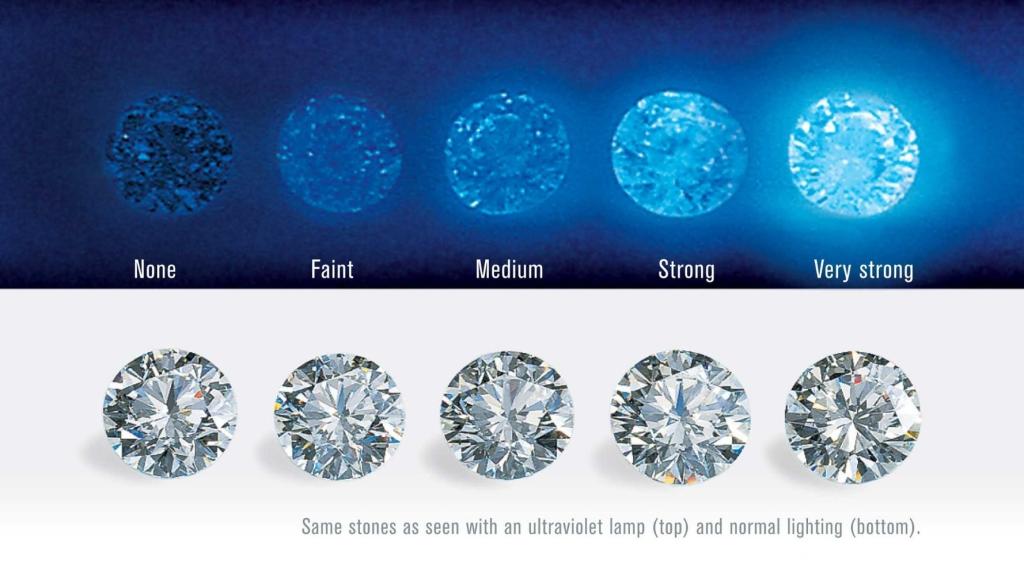
This seems to have a love and hate relationship. Some people are very pro fluorescence, and some people are very against it. Either way the GIA regard it as a diamond flaw, and it can lower the grading of a stone.
I personally LOVE seeing fluorescence, it is a natural occurrence in natural stones – Lab-grown cannot (as of 206) produce this phenomenon. This is a characteristic of the stone when it has a UV light shone on the stone. It can glow a certain colour (usually blue). Again, GIA grades these by none to very strong. The Stronger the fluorescence, the ‘lesser’ the stone quality.
Now, a stone having fluorescence can be a good thing – if you have a lower coloured stone. Just like hair bleaching, blue/ purple off-set yellow to produce white. So the same colour theory applied to the stones. If you have a yellow stone but with a very strong fluorescence then your stone could appear whiter than it is in neutral light. Some enthusiasts like to think that this can cause a stone cloudiness, which is false. If your stone already has cloudiness, then this might make it potentially more obvious. https://4cs.gia.edu/en-us/blog/diamond-fluorescence-good-bad/
The most fun thing? Depending what your diamond is made from, it could have difference colours under UV light! Most grading labs will include this on their reports, as this essentially can still effect the stones overall colour.
Here is a video from GIA seminar which goes into real depth about how these glowing stones are made and influence the stones characteristics.
I am going to move onto some more ‘controversial’ gradings which can be done. Now, GIA does not cover hearts and arrows gradings in their reports. Even though the GIA report might state 4 x excellent on their 4Cs, it does not mean it could be a ‘perfect’ diamond. This is where some other cleaver little tools and a little bit of maths comes into play when looking at Diamond proportions.
Hearts and Arrows
Ok, so I have a confession to make. I brought a lab grown diamond.
There is specifically a reason as to why I did – to see a true hearts and arrows.
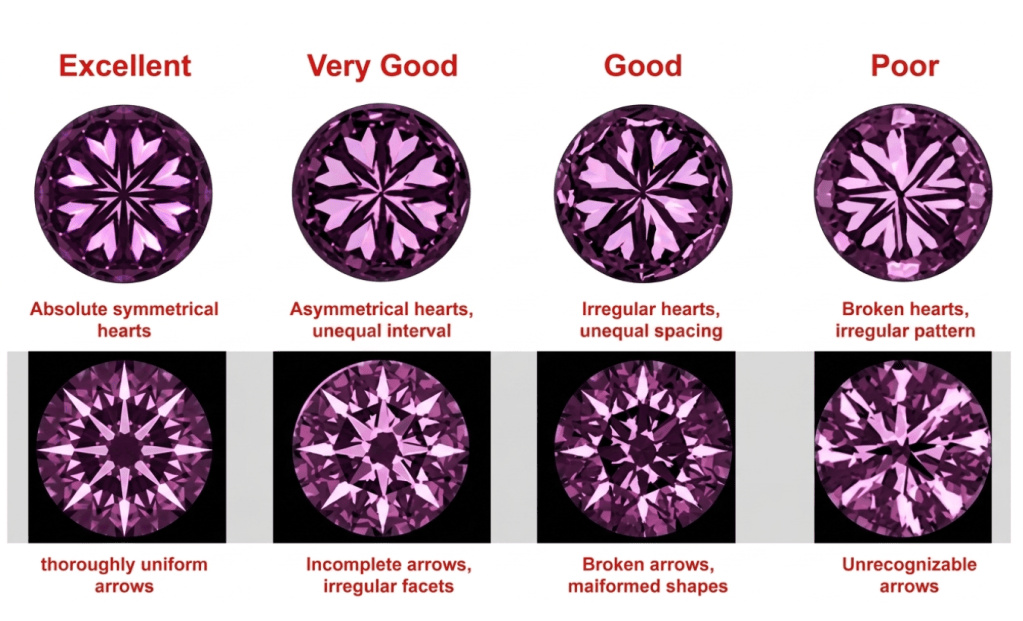
So, hearts and arrows are a specialised cut in the diamond which demonstrates the craftsmanship done on a stone. Hearts can be seen on the underside of the stone, whilst arrows can be seen on the topside of the stone. There are certain criteria which makes a stone a ‘true’ hearts and diamond:
- 8 equal, symmetrical and uniform hearts
- The hearts are distinct and separate from the arrow heads which lie above. There should be a gap which should be crisp and clear
- There should be no clefs in the outer, middle side of the heart.
The hearts and arrows are a means of being able to create a balanced sparkle.
Having a hearts and arrows diamond is like having a VVS1 clarity and Flawless. Nobody will know except your little certificate and the guys in a lab.
Further reading:
IGI Report of a Lab-grown diamond
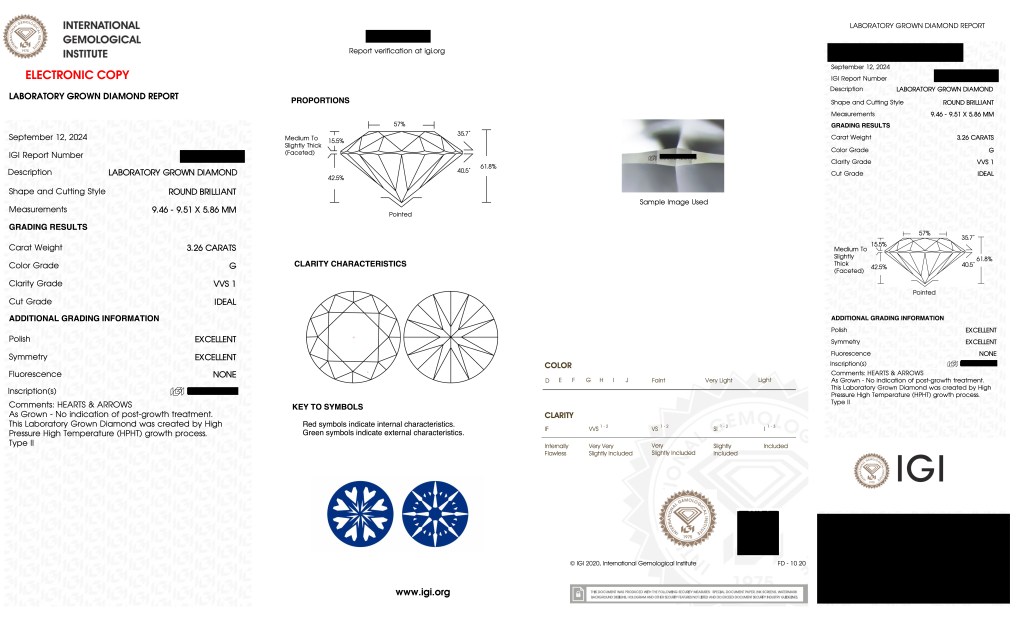
To bring things into perspective, here is a £400, 3ct lab grown diamond which I purchased. Points to note are:
Comments: HEARTS & ARROWS
As Grown – No indication of post-growth treatment. This Laboratory Grown Diamond was created by High Pressure High Temperature (HPHT) growth process. Type II
Also: Cut grade – Ideal.
I am not here to gloat, but here to talk about proportions and if this were a natural stone, I would never of been able to secure it for £400! Instead, I am trying to say, there are magic numbers in which when searching for a ‘ideal’ stone they fall under this category. As I said, there is. bit of maths which can help you find the ‘ideal’ diamond.
I will explain lab-grown types and ideal proportions but not just yet.
ASET Scope
The ASET scope is possibly one of my favourite inventions because it is so simple. The idea of the ASET scope is to help detect the light-loss of the stone. Basically, trying to see if you’re stone is the shiniest stone on the market. The thing is, an ASET scope is so reasonably priced and anyone can use one. The GIA does recognise this as a point of grading. From 2024, the GIA approved having the ASET scope results printed onto their reports. ASET scopes are also
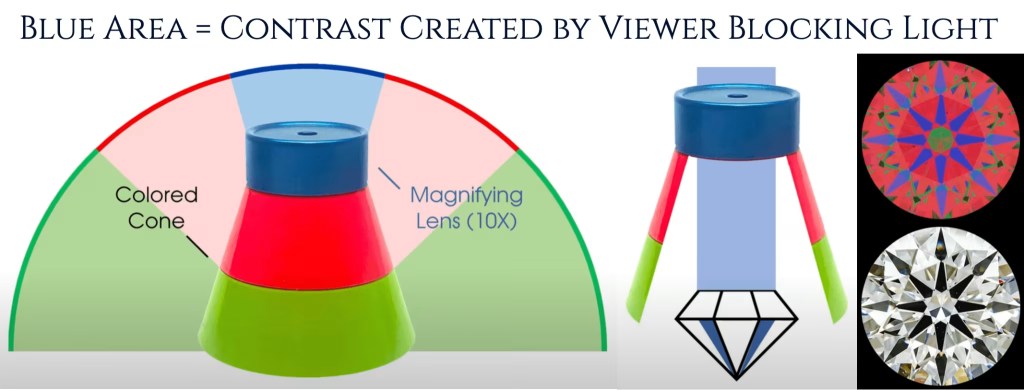
Now, the ASET scope was invented by Garry Holloway (Jeweller and also inventor of the Ideal Scope) and Al Gilbertson (Researcher working with AGS). The thing I enjoy is their website: https://ideal-scope.com/reference-chart-aset-images/
What do the colours mean?
Blue –
Contrast. Due to Observer’s head – Distribution important – Around 18% – desirable
Red –
Brightness – High is desirable
Green –
Reflection of light from lower angels replace by Red if possible
Black / White –
Leakage – Would want to Minimise this
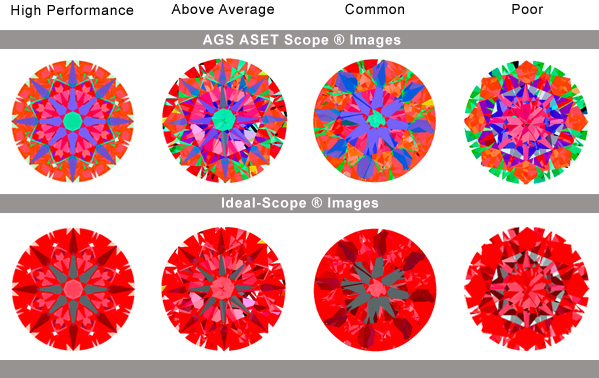
Scope differences
| Feature | Hearts and Arrows | Aset (Angular Spectrum Evaluation Tool) |
| What it measures | Optical symmetry and precision alignment of all 57 facets in a round brilliant diamond. | Light performance—specifically where light enters, reflects, leaks, or gets blocked from all angles. |
| How it is viewed | Through a specialised H&A or Ideal scope (crown view shows 8 arrows, pavilion/back view shows 8 hearts). | Through an ASET scope using coloured reflectors (red for direct light return, green for external reflection, blue for obstruction, white/light areas for leakage). |
| Primary purpose | Proof of extreme craft and exact facet-to-facet symmetry. | Diagnostic mapping of brilliance, fire, scintillation, and hidden light-leakage defects. |
| Limitation | A symmetric H&A pattern does not guarantee zero light leakage or optimal internal light return. | An ASET map evaluates light behaviour, though it may not isolate minor twist/indexing symmetry flaws as crisply as an H&A viewer. |
| Rarity / Cost | Represents <1% of round brilliants and adds a 10–20% market premium. | A diagnostic tool/report layer used by high-end ideal-cut labs (like AGS) or signature brands to validate performance. |
This video helps to show how the cut of a stone can be measured using the ideal-scope
Here is another video showing how a hearts and arrows scope can be made so simply with a piece of card with a specialist filter built in:
Learn more about Scopes:

