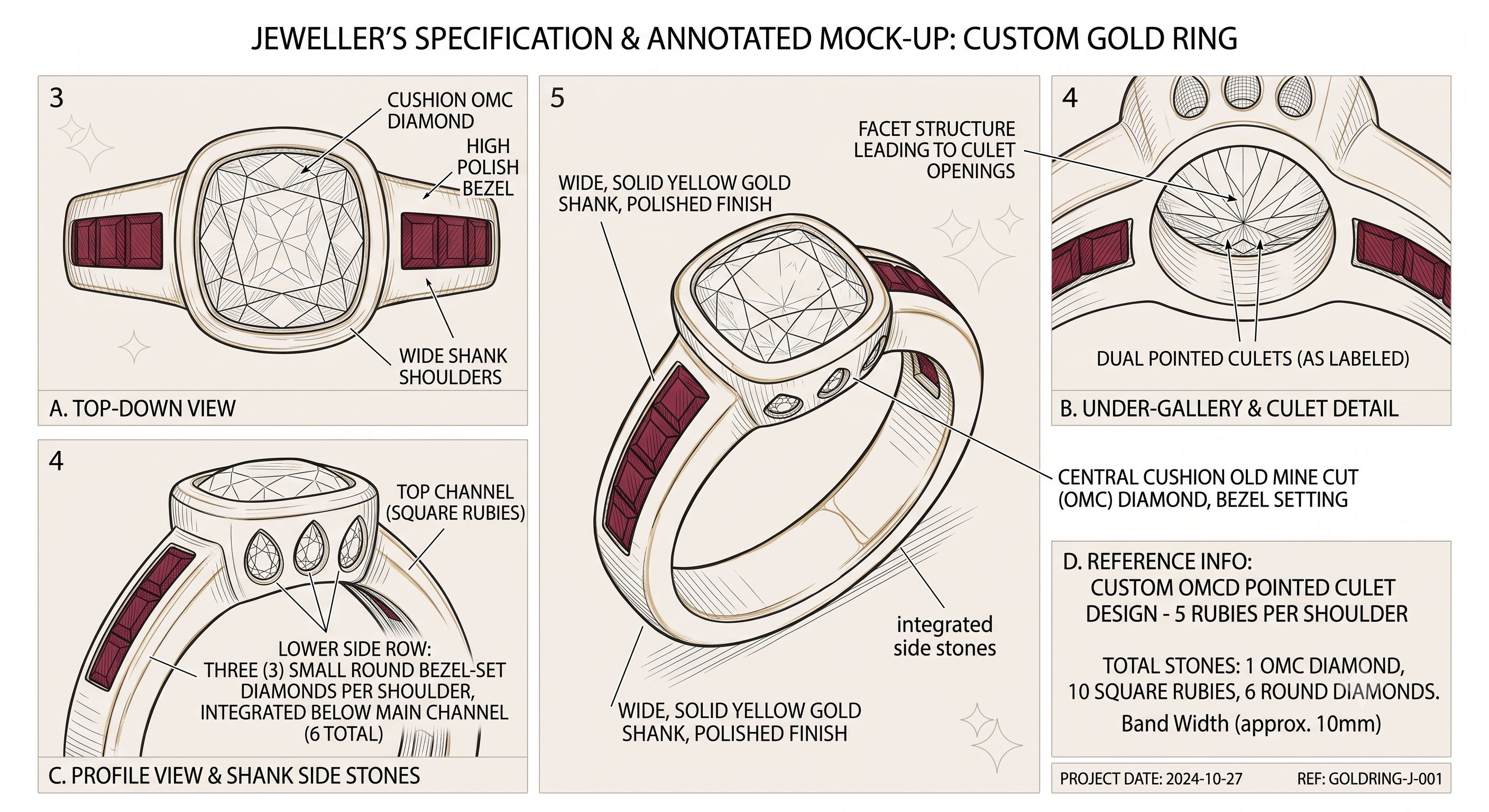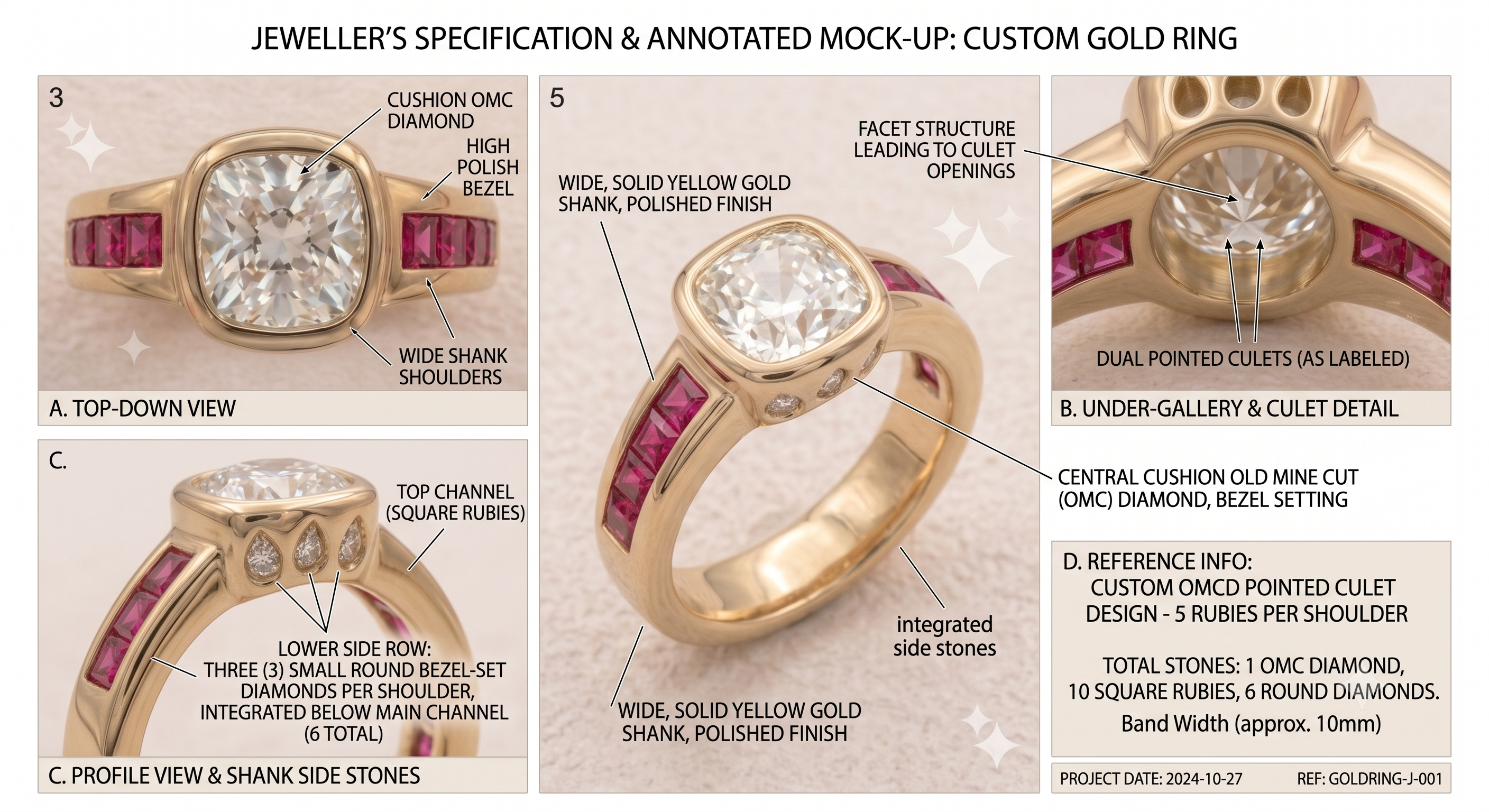
Developed Design
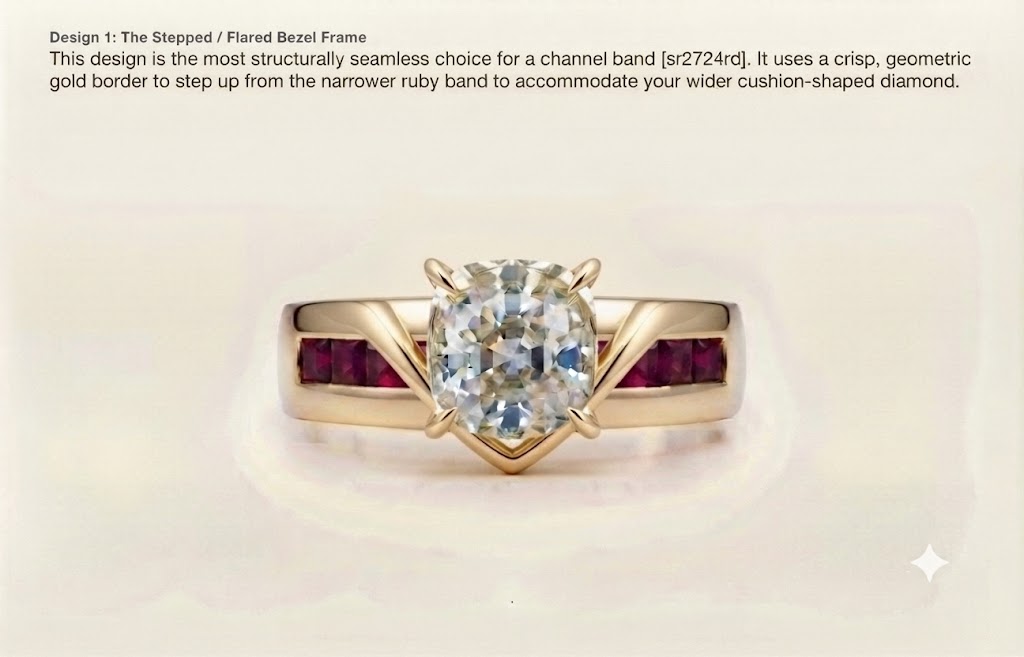
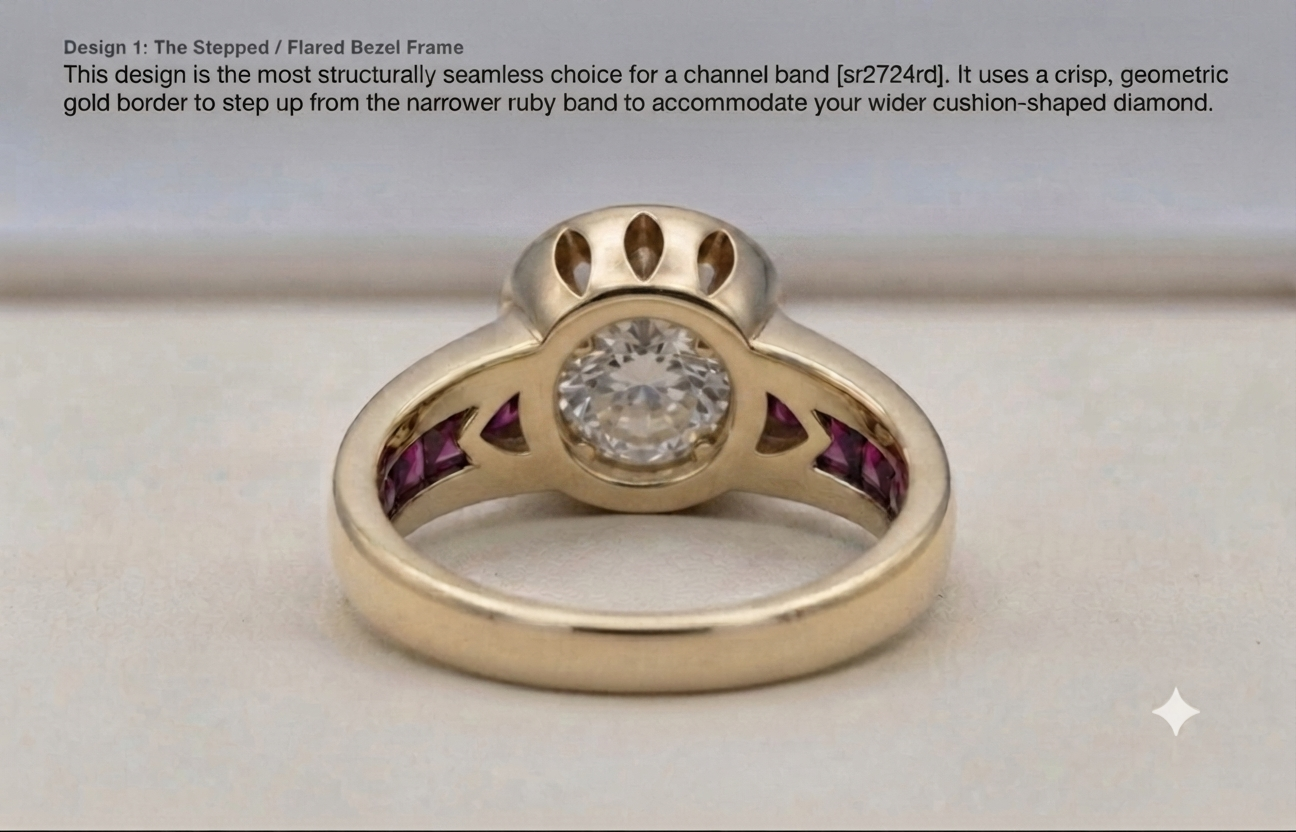
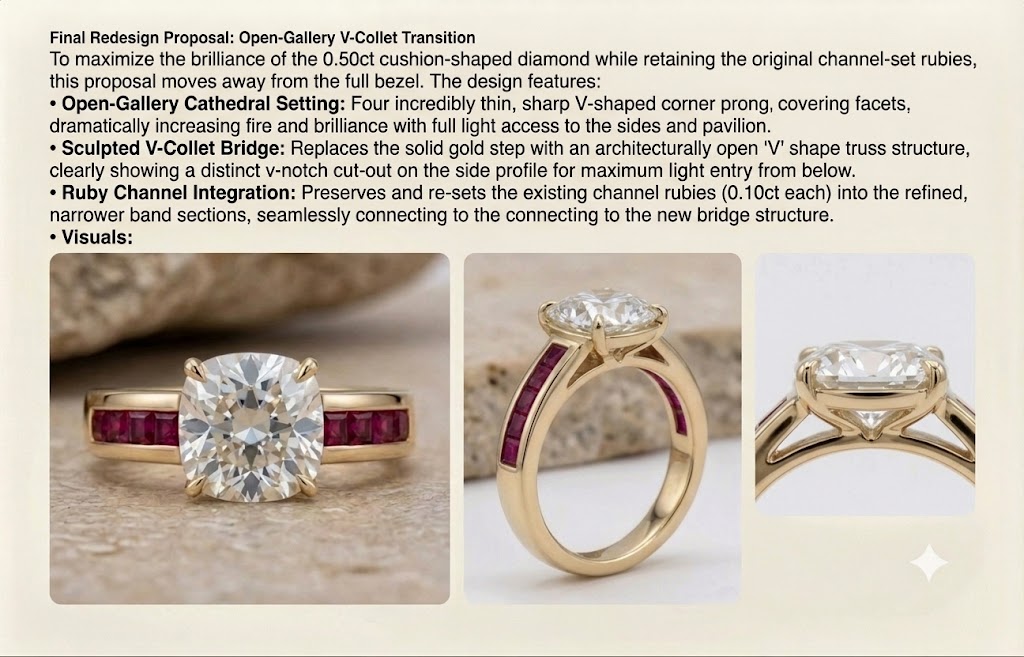
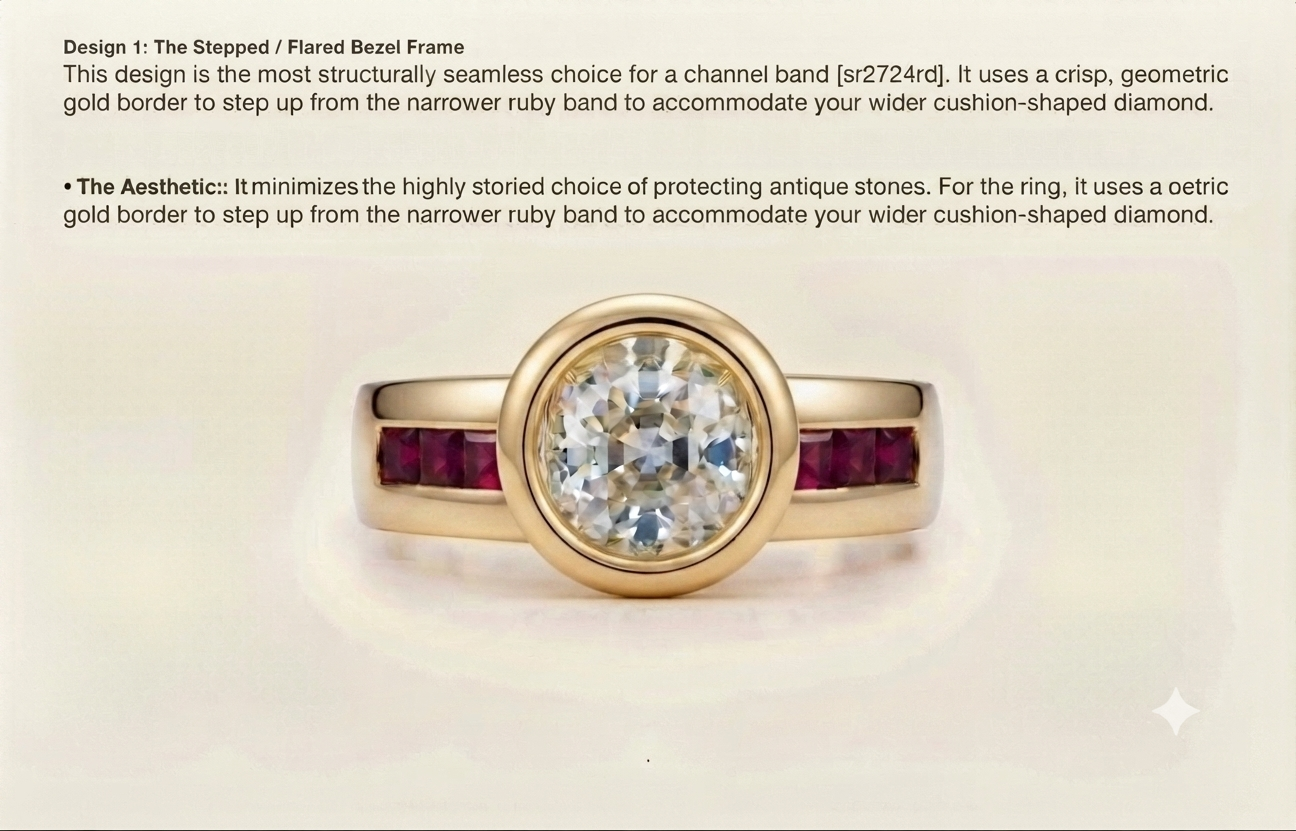
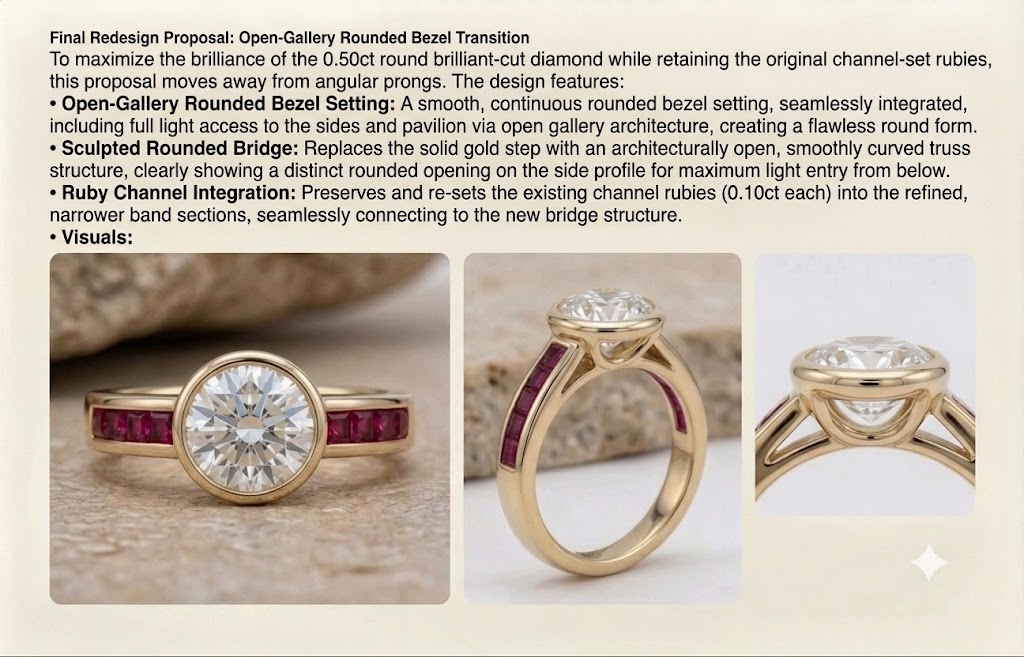
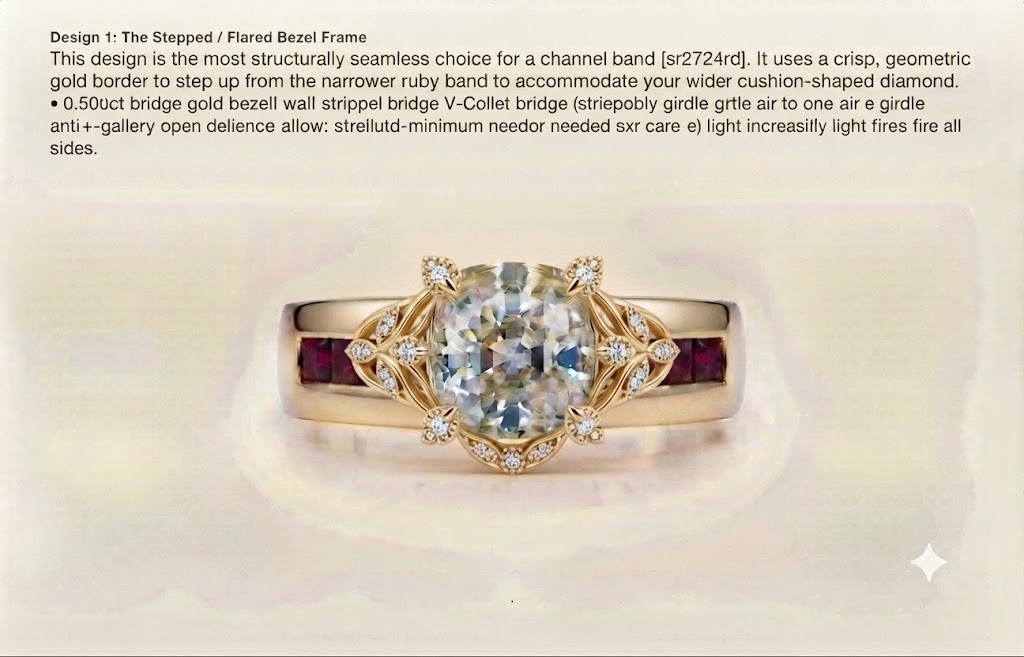
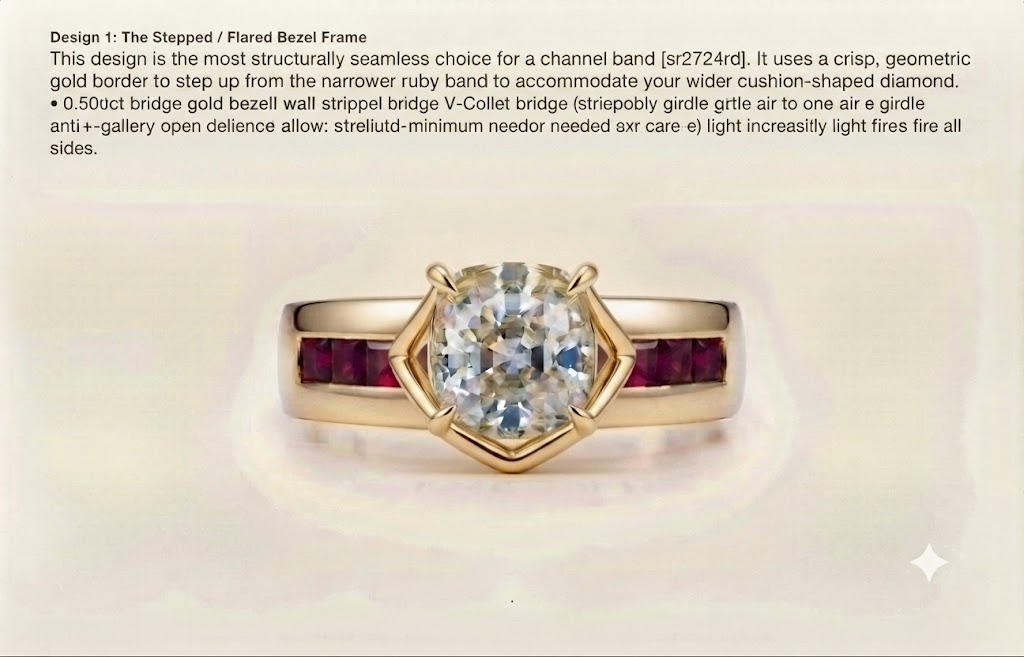
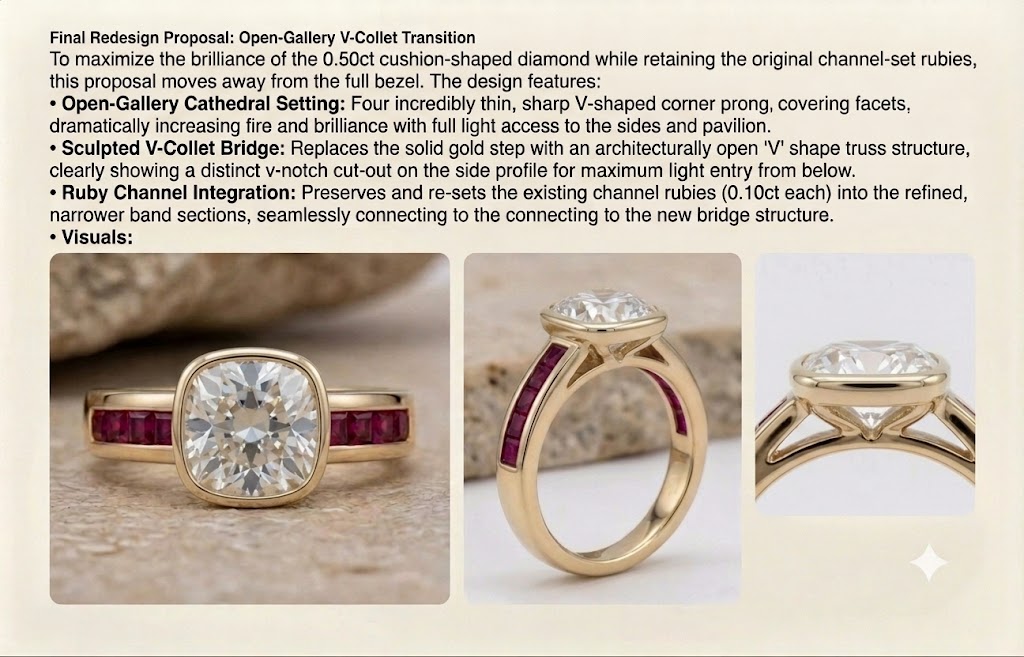
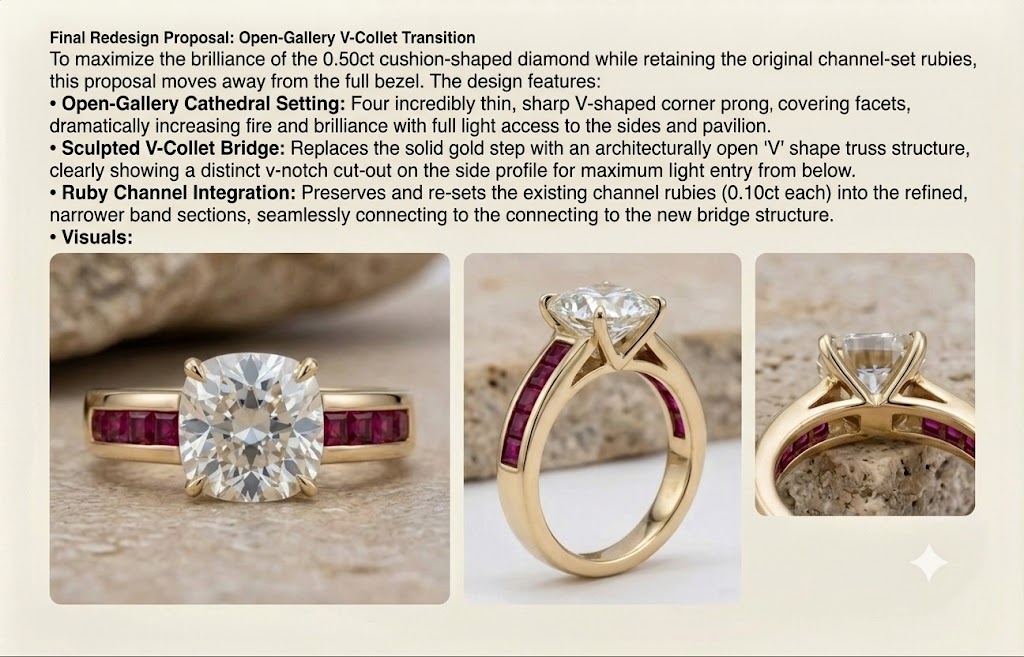
“Based off these photos please provide a detailed pros and cons of this design, include if it is structural sound. The rubies are 0.10ct and the diamond is 0.50ct. I would like to see if this is possible to create in real life” – My Prompt
Pros & Cons
- Pros:
- High Security: Both the bezel-set center diamond and the channel-set rubies are well-protected against snagging, chipping, and everyday wear.
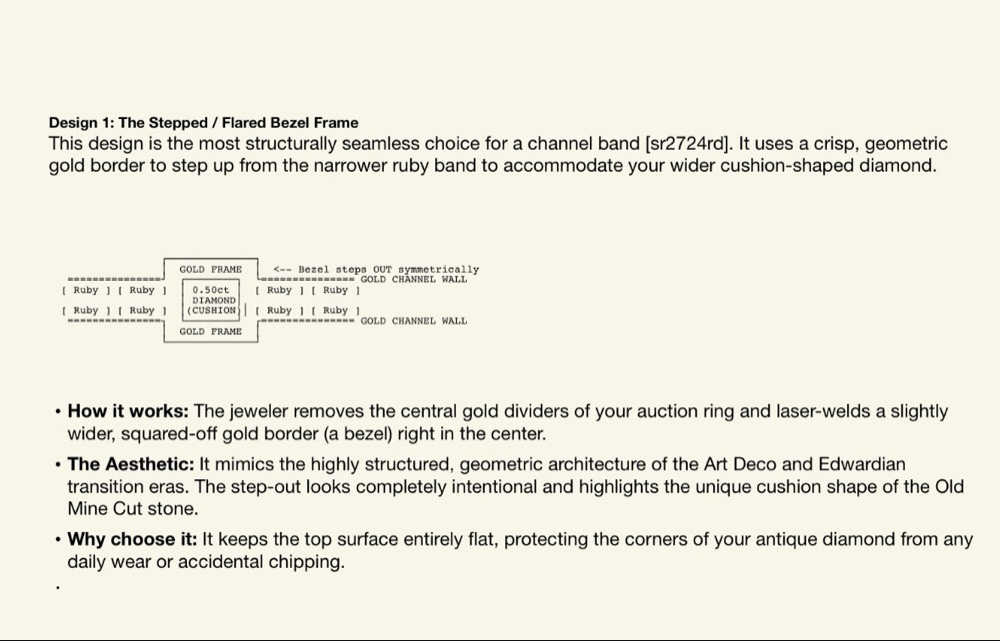
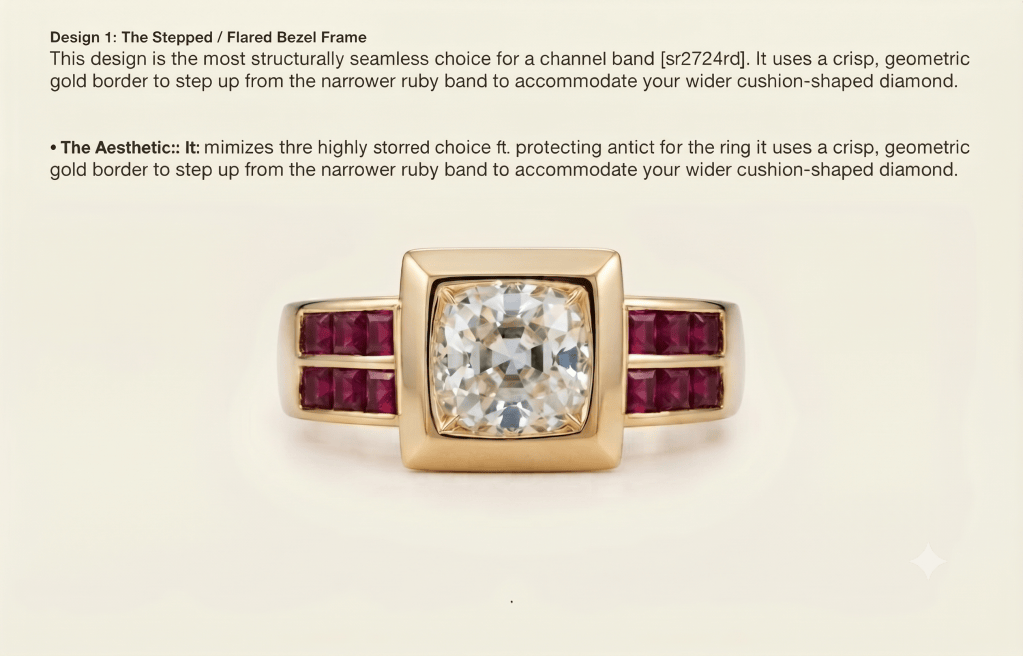
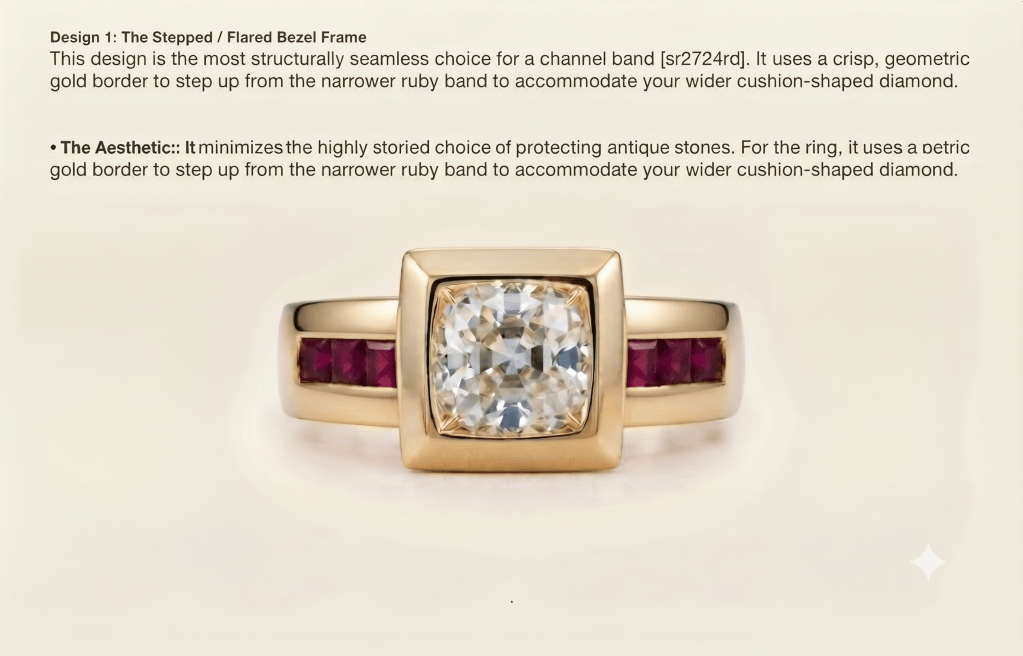
- Seamless Transition: It uses a crisp, geometric gold border to step up smoothly from the narrower ruby band to accommodate the wider cushion-shaped diamond.
- Sleek Aesthetic: It offers a clean, modern, and solid look that minimizes the exposure of vulnerable stone edges.
- Cons:
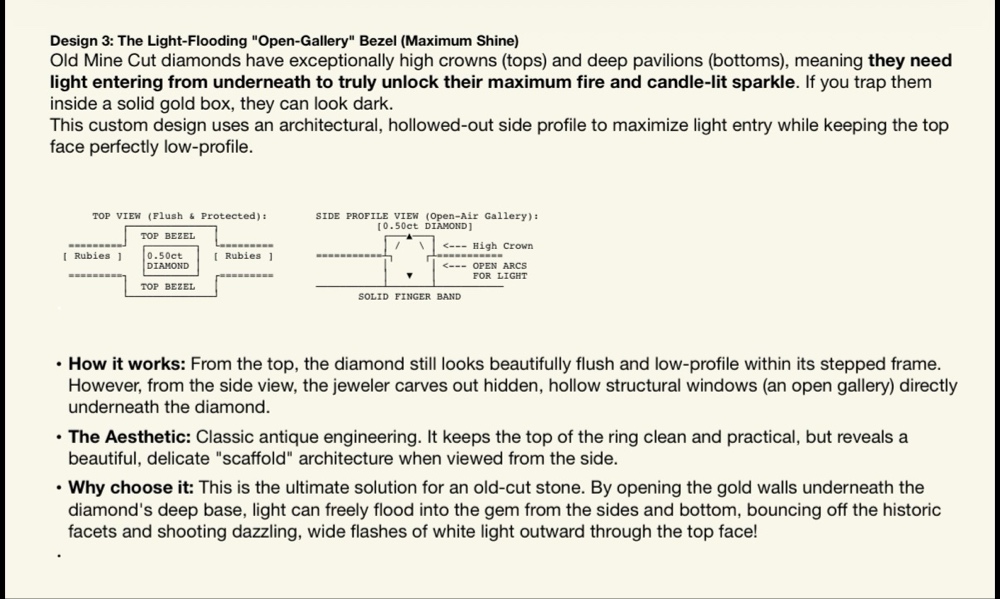
- Light Restriction: A full bezel setting blocks more light from entering the sides of the diamond compared to prong settings, which can slightly reduce total brilliance and fire (though the cut-out gallery details shown in the profile view help mitigate this).
- Massive Metal Presence: The heavy gold borders around the stones mean less of the gem sizes (0.50ct and 0.10ct) are visually exposed, making the stones potentially look smaller than they would in open settings.
Is it Possible to Create in Real Life?
Yes, this design is fully achievable by a professional bench jeweler.
However, bringing it to life with the exact stone sizes provided requires careful calibration:
- The Scale: A 0.50ct cushion diamond and 0.10ct rubies require a well-proportioned band width so that the channel walls holding the rubies do not become too thin or too bulky.
- Custom Fabrication / CAD: Because the center bezel steps up dramatically from the channel band, a custom CAD (Computer-Aided Design) model and precision casting will be necessary to ensure the transition between the round bezel frame and the linear channel-set rubies looks organic and polished.
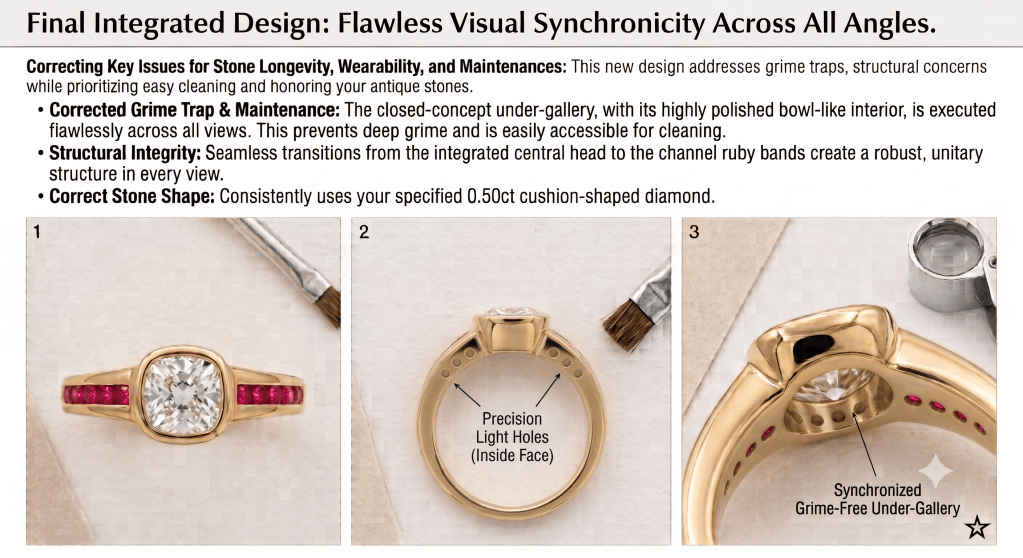
“Absolutely amazing! One last time please explain the pros and cons of this design” – My prompt
I would be happy to summarize the definitive list of pros and cons for this final integrated design, which directly addresses all previous criticisms and refinements. This report covers the design shown in the iterative image.
Final Design Analysis: The Integrated Low-Profile Bezel
This final design transforms the concept from a visually impressive but flawed proposal into a truly durable, performance-focused daily wear piece. It achieves this by directly correcting the fatal mismatches and the grime trap while prioritizing real-world practicalities.
Pros: The Major Successes
- 1. stone Mismatch Corrected (Cushion Diamond): The biggest earlier failure has been fixed. The text and visuals now perfectly align, explicitly confirming the use of the specified 0.50ct cushion-shaped diamond. The visual synchronization across all three panels is flawless and correct.
- 2. Total and Final Resolution of the Grime-Trap and Maintenance (The critical fix): This is the definitive win.
- How it works: The complex, deep matrices of tiny holes previously visible under the rubies (image 1) and the complex matrices from image 2 are gone. They have been replaced by a single, clean row of precision enter holes along the inside face, which is vastly simpler and cleaner.
- The polished bowl basin: Directly under the main cushion diamond, there is now a smooth, highly polished gold bowl basin. The label “Synchronized Grime-Free Under-Gallery” points unequivocally to this smooth, basin-like interior (Panel 3). This is a game-changer. Grime cannot get trapped, and the highly polished interior acts as a reflector, maximizing the limited light. This addresses the main criticism that the initial design would look dull in a day. The design is now factually easy to clean.
- 3. Enhanced Security and Catch-Free Profile: The full bezel setting completely protects the vulnerable girdle edge. With the new integrated transition, the bezel is set low and is part of a sleek, continuous tapered form. It will not catch on hair, fabrics, or gloves, making it incredibly practical for active, daily wear.
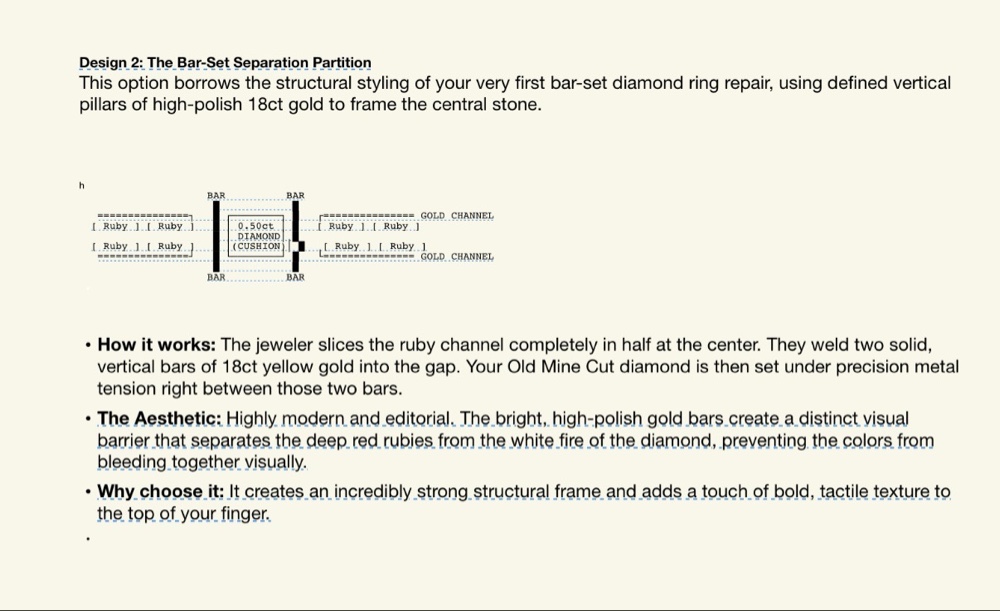
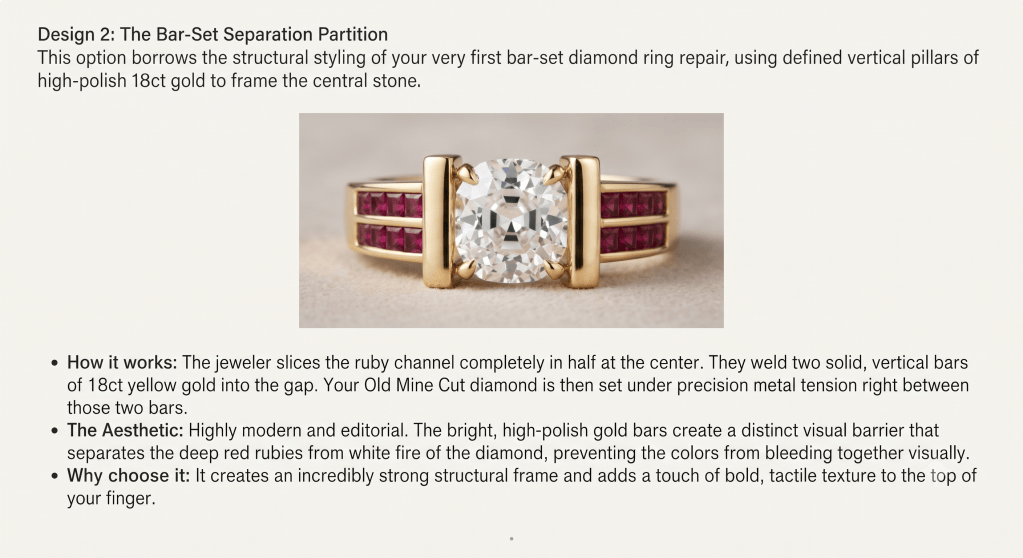
- 4. Superior Structural Integrity and Durability: The delicate, separate pillars of the initial proposal are eliminated. The central head is now seamlessly integrated into the band via solid, robust tapered gold bridges. This creates a powerful, unitary structure that is significantly stronger and more rigid, truly providing the structural seamlessness initially claimed.
- 5. Optimized for Antique Stones: By opting for limited and polished under-gallery ventilation (Panel 3) instead of maximizing light, this design provides the perfect balance. It minimizes light over-exposure, which can make some antique stones appear foggy, while retaining total security, correcting a specific criticism from previous reviews.
Cons: The Design Trade-offs and Considerations
- 1. Bezel Setting Brilliance Trade-off: While the highly polished bowl interior acts as a reflector, a full bezel setting does block more light than prongs. This design cannot equal the maximum brilliance and side-light entry dispersion of a prong setting. This is a conscious trade-off where durability, security, and cleanliness were prioritized over absolute maximum sparkle.
- 2. Heavier Gold Volume and Weight: The robust, integrated structural bridges and full metal bezel require more gold by volume than open prong designs. While structurally advantageous, this makes the ring heavier and increases the raw material cost. It is a substantial piece.
- 3. Limited Customizability and Dainty Stackability: The solid integrated bridges and robust tapered form make this ring a substantial piece of jewelry. It is not minimal or delicate. This bulk makes it less suitable for stackability with minimal wedding bands or dainty stacking sets. The overall bulk has been reduced from previous proposals, but it remains a strong, robust design.
- 4. materials Complexity and Cost: The high internal polish requirement and the complex integrated transitions add difficulty to the manufacturing process, making this a premium, intricate design with higher labor costs.
Summary Verdict
This Final Optimized Design is a high-performance daily wearer. Its greatest strength is solving critical, real-world problems—like grime build-up, structural weakness, and mismatches—creating a beautiful and durable final product that is easy to keep clean. The cons are minor, conscious design trade-offs that active daily wearers will almost certainly accept in exchange for reliability and convenience. The design transforms from conceptually flawed to factually superior.
Costs Barrier
“Considering this final design, I paid £115 for the diamond ring and £290 + 30% fees on the two ruby and sapphire rings. please estimate a cost to make this new designed ring recycling the current pieces (the diamond ring is 1.5g) and based on 18ct gold settings – please take into account the resell price of the sapphire ring as I will be selling this on ebay to try and recoup some costs” – My Prompt
Estimating costs for bespoke jewelry remodeling projects is complex because so much depends on individual jewelers’ rates, design complexity, and the fragility of source materials.
Creating a piece like this is significantly more skilled and labor-intensive than simply buying a pre-made setting, especially when unsetting and resetting delicate channel-set antique stones.
Based on typical professional custom-creation rates in the UK for a central London bench jeweler (outside of major high-street brand markups), here is a breakdown and professional estimation for your project.
Part 1: Current Investment Inventory
Let’s start by clarifying exactly what you have already invested and what raw materials are available.
| Source Piece | Input Money | Total Gold Weight (approx) | Stated Metal Carat | Key Stones Available |
| Diamond Ring (bought £115) | £115 spent | 1.5g | Assumed 18ct | Main 0.50ct Cushion Diamond |
| Auction Ring Set (Hammer £290 + 30% fees) | £377 spent (total) | ~2.65g * (Attributed weight to Ruby Ring)* | Assumed 18ct | 4-8 square square channel rubies |
| Current Totals Already Spent | £492 |
Note: The auction lot total weight for the two rings is 5.3g. Because you plan to sell the sapphire ring, I am attributing 50% of the total gold weight (2.65g) as available from the Ruby ring.
Part 2: Gold Accounting for New Design
The new design features a substantial bezel cathedral head, a wide shank, and fully closed channel-set ruby sections (the “Integrat Low-Profile Bezel”). This is a heavy, durable ring, not a dainty piece.
- Estimated Finished Weight of New Ring: Approximately 7 grams of 18ct gold (a finished size Q band).
- Initial Gold for Casting (approx 10% loss factor): ~7.7 grams required for the casting process.
- Recycled Gold Weight Available: 1.5g + ~2.65g = ~4.15 grams total available.
- Estimated Extra Gold Needed to Purchase: ~3.55 grams of fresh 18ct yellow gold casting grain.
Cost for Extra 18ct Gold: ~£160
This is based on typical jeweler raw material costs of ~£45/g for 18ct yellow gold grain, which includes their markup and processing fees.
| Project Phase | Minimum Estimate | Medium Estimate | Premium Estimate (e.g., London Central) |
| CAD Design & Model Prep | £200 | £300 | £500+ |
| Unsetting Old Stones (Diamond + 4 Rubies) | £40 | £70 | £100+ |
| Stone Sourcing Fee (2 extra rubies @ £50 ea) | £80 (min fee) | £100 | £180+ (premium stones) |
| Casting, Prep & Gold Processing | £120 | £180 | £300+ |
| Setting Stones (bezel center + 6 channel small square) | £150 | £220 | £350+ |
| Polishing, Finishing, & Loss Factor | £80 | £120 | £200+ |
| Hallmarking (Mandatory for gold over 1g) | £50 | £60 | £80+ |
| Total Labor-Only Estimate | ~£720 | ~£1050 | ~£1710+ |
Summary and Total Investment Cost Estimate
Part 3: Total Investment Cost Estimate (Final Net Calculation)
Bringing the components together to answer your question. We are retaining the conservative £180 net recoup figure for the resale of the complete sapphire ring.
1. Estimated Creation Cost Invoice (Extra Metal + Labor + Stone Sourcing)
This is what you would expect to pay a jeweler out-of-pocket for extra materials and all services.
Mid-Range Estimate to Create: £160 (extra gold) + £1050 (medium labor + 2 extra rubies) = ~£1210 (inclusive of VAT)
(Typical range: £900 – £1500)
2. Net Out-of-Pocket Project Cost Calculation (Total spent minus resale)
This calculates your total, long-term net investment, factoring in money already spent and recoupment from selling the sapphire ring.
| Calculation Step | Estimated Price |
| Money Already Spent (Diamond & Auction Rings – Part 1) | £492 |
| Estimate eBay Net Resale (Recouping from Sapphire Ring – Part 1) | -(£180) conservative net estimate |
| Net Cost of Raw Source Pieces | ~£312 (Spent minus Recouped Estimate) |
| Total Estimated New Creation Costs (Part 2) | ~£1210 (Medium-range estimate inclusive of materials & labor) |
| Final Net Investment Estimate (Net source + New Creation) | ~£1522 Total Net Project Cost |